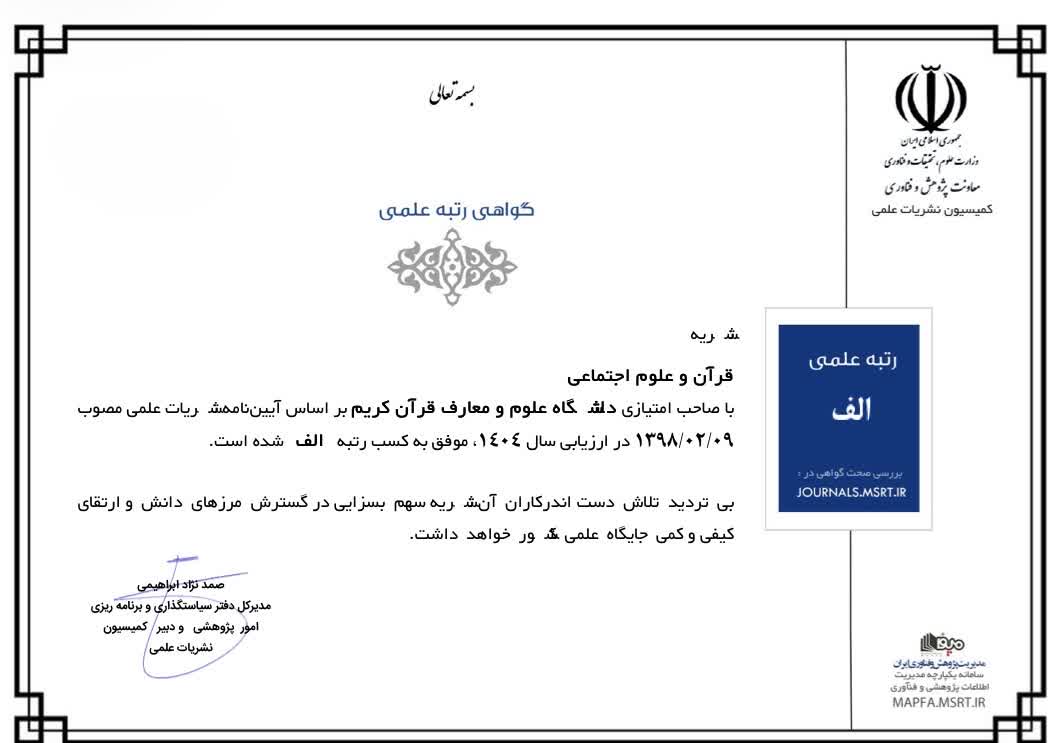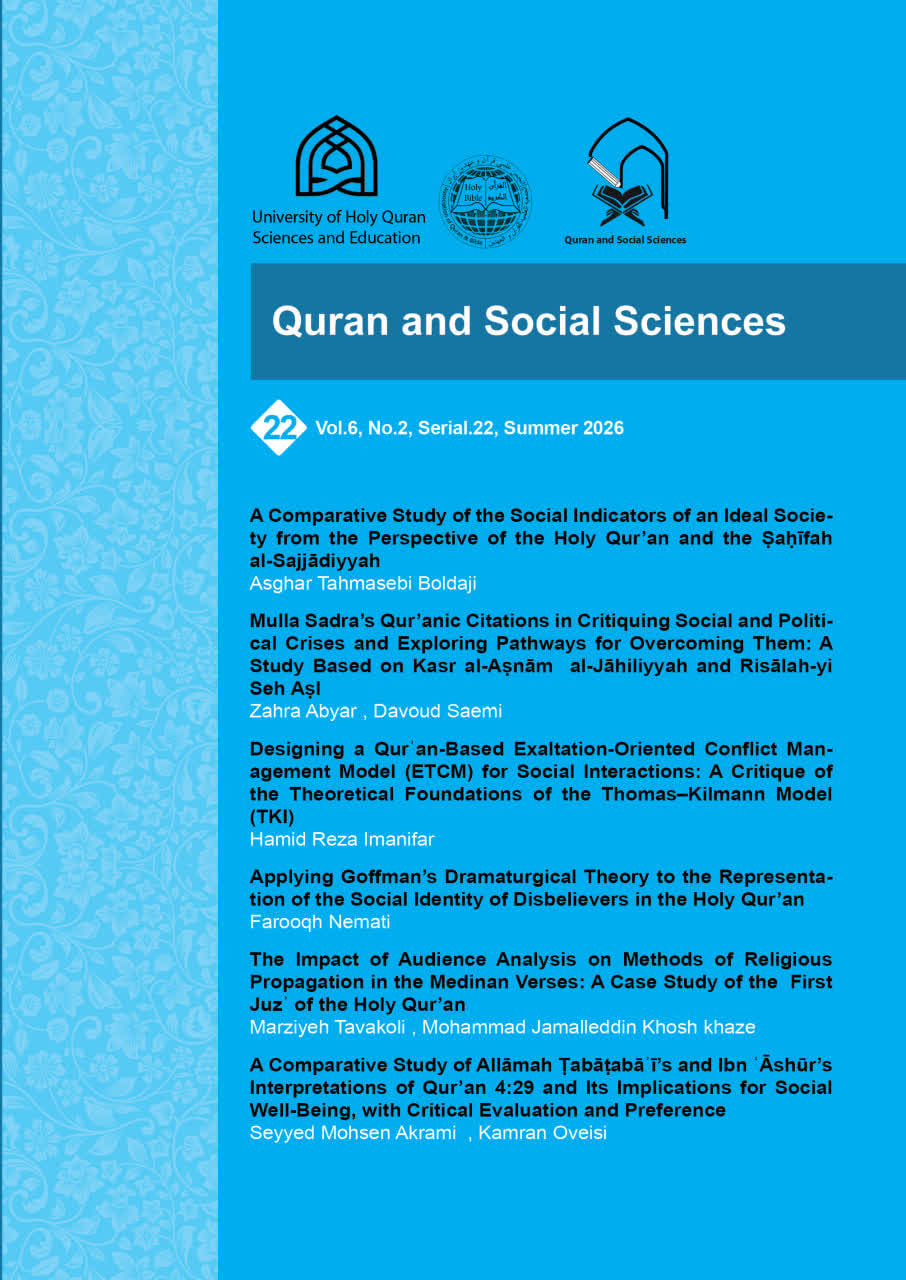
Qur’an and Social Sciences

Qur’an and Social Sciences

Number of Volumes 5
Number of Issues 19
Number of Articles 115
Number of Contributors 213
Article View 220,976
PDF Download 121,327
View Per Article 1921.53
PDF Download Per Article 1055.02
Number of Submissions 583
Rejected Submissions 370
Reject Rate 63
Accepted Submissions 124
Acceptance Rate 21
Time to Accept (Days) 151
Number of Indexing Databases 12
Number of Reviewers 69

Journal Title: Qur’an and Social Sciences 

Country of Publication: Iran, Shahrud

Publisher: University of Holy Quran Sciences and Education

Director-in-Charge: Davoud Saemi

Editor-in-Chief: Ebrahim Ebrahimi

Subject Area: Quranic sciences, social sciences, education, ethics in the Quran, social relations, family, educational issues, etc.

Format: Online

Start Year: 2021

Permission of the Ministry of Guidance: Yes. 

Online ISSN: 3060-5644

Frequency: Quarterly

Language: Persian, including English abstracts 

Open Access: Yes, free access to articles

Article types: Research and review papers.

Primary Review: 10 days, approximately.

Peer Review Policy: Double-blind peer-review

Average refereeing time: 4-8 weeks

Acceptance percentage: 21%

Article Processing Charges:  Review: 2.500.000 Rials; Accepte: 4.500.000 Rials

Citation Style: The APA referencing style.

Website: https://arq.quran.ac.ir/?lang=en

E-mail: tahhighat.qh@quran.ac.ir

Assignment of DOI code to articles: Yes. Articles have a doi code.

Indexing & Abstracting: ISSN-ROAD, Noormags, Magiran, Google Scholar, Academia, LinkedIn, Civilica, etc.

COPE: The journal of Qur’an and Social Sciences follows the policies and guidelines of the Committee on Publication Ethics (COPE) and abides by its Code of Conduct in dealing with potential cases of misconduct.

Copyright: Authors retain unrestricted copyrights and publishing rights.

Type of License: Creative Commons — Attribution-NonCommercial 4.0 International (CC BY-NC 4.0)

Required files to be uploaded: 4 essential files must be submitted through the manuscript submission system: 1. The main file of the manuscript (without the names of the authors), 2. Title page in the mentioned format, 3. Authorship form (must include the title of the article and the name and surname of all authors and be signed by all authors), 4. Conflicts of Interest form (must be signed by the Corresponding Author and uploaded with the article file).

Keywords Cloud

  • Quran
  • Society
  • Lifestyle
  • Qur\'an
  • the Holy Qur’an
  • Women
  • social education
  • content analysis
  • the Quran
  • the Holy Qur\'an
  • Ayatollah Javadi Amoli
  • moderation
  • supreme leader
  • ethics
  • semantics
  • causality
  • Education
  • Islamic society
  • Social harms
  • educational components
  • Imam Reza (AS)
  • function
  • self-knowledge
  • Solutions
  • ignorance
  • Political education
  • man
  • social relations
  • Imam Ali (AS)
  • Foundations of Social Interpretation
  • Gender Justice
  • Celebrity
  • The Holy Quran
  • Communication skills
  • Polytheism
  • Social Justice
  • Holy Qur\'an
  • Tafsir al-Mizan
  • an
  • children
  • Islamic Government
  • Holy Qur’an
  • Religious Democracy
  • Social Solidarity
  • Trust
  • rationality
  • freedom
  • university
  • Management
  • Human Communication
  • Sovereignty
  • Free Will
  • social impact
  • self-control
  • Religious identity
  • Marriage
  • Social Capital
  • social commitment
  • Emigration
  • Students
  • Islamic mysticism
  • Prevention
  • faith
  • Power
  • Media functions
  • Islamic media
  • Grounded theory
  • Characteristics
  • Authority
  • Challenges
  • Policy making
  • communication
  • interpretation
  • Strategies
  • Accountability
  • Islamic awakening
  • Ayatollah Khamenei
  • Reproduction
  • Future Studies
  • context
  • Parents
  • Social Interactions
  • ownership
  • explanation
  • citizenship rights
  • Woman
  • Sunnah
  • Hadith
  • social responsibility
  • Social Empowerment
  • Directed Content Analysis
  • Family
  • leisure time
  • Death
  • Practical Ethics
  • Ibn Taymiyyah
  • Love of God
  • Foresight
  • Allamah Tabatabaei
  • social policy
  • authoritarianism
  • identity
  • moral virtues
  • affection
  • Development
  • love
  • employment
  • psychology
  • problem solving
  • Addiction
  • Personality components
  • honesty
  • Javadi Amoli
  • Islam
  • social studies
  • effectiveness
  • characters
  • moral motivation
  • Tabatabai
  • social change
  • Islamic University
  • Modern Islamic Civilization
  • Tradition
  • structure
  • Nahj al-Balagha
  • anxiety
  • hope
  • Application
  • Aristotle
  • Islamic
  • community
  • model
  • Relationship
  • Methods
  • Law
  • gender differences
  • Criminal law
  • reason
  • Responsibility
  • Judge
  • Prosocial Behavior
  • scientism
  • Fear
  • structural interpretation
  • parable
  • Imprisonment
  • social system
  • Sociology of Religion
  • extravagance
  • Choice
  • Social participation
  • Approach
  • harm
  • Restorative justice
  • Spiritual Health
  • Insight
  • Obstacles
  • Goals
  • Monotheism
  • consultation
  • Islamic approach
  • governmental jurisprudence
  • socio-cultural
  • Ayatollah Mesbah Yazdi
  • exploitation
  • Social development
  • hadiths
  • Self-Purification
  • Islamic lifestyle
  • economic education
  • Succession
  • Educational Method
  • anfal
  • satire
  • Support
  • Critical analysis
  • Nahj al-Balaghah
  • male students
  • Human life
  • Elementary School
  • confrontation
  • speech act theory
  • Gender
  • universality
  • mystical interpretation
  • narrative interpretation
  • method of interpretation
  • Moral education
  • oppressor
  • Behavioral Deviations
  • social communication
  • Component analysis
  • Entertainment
  • birth
  • Men
  • Divine Traditions
  • Textbooks
  • Self-alienation
  • positive attitude
  • signs

Related Journals